
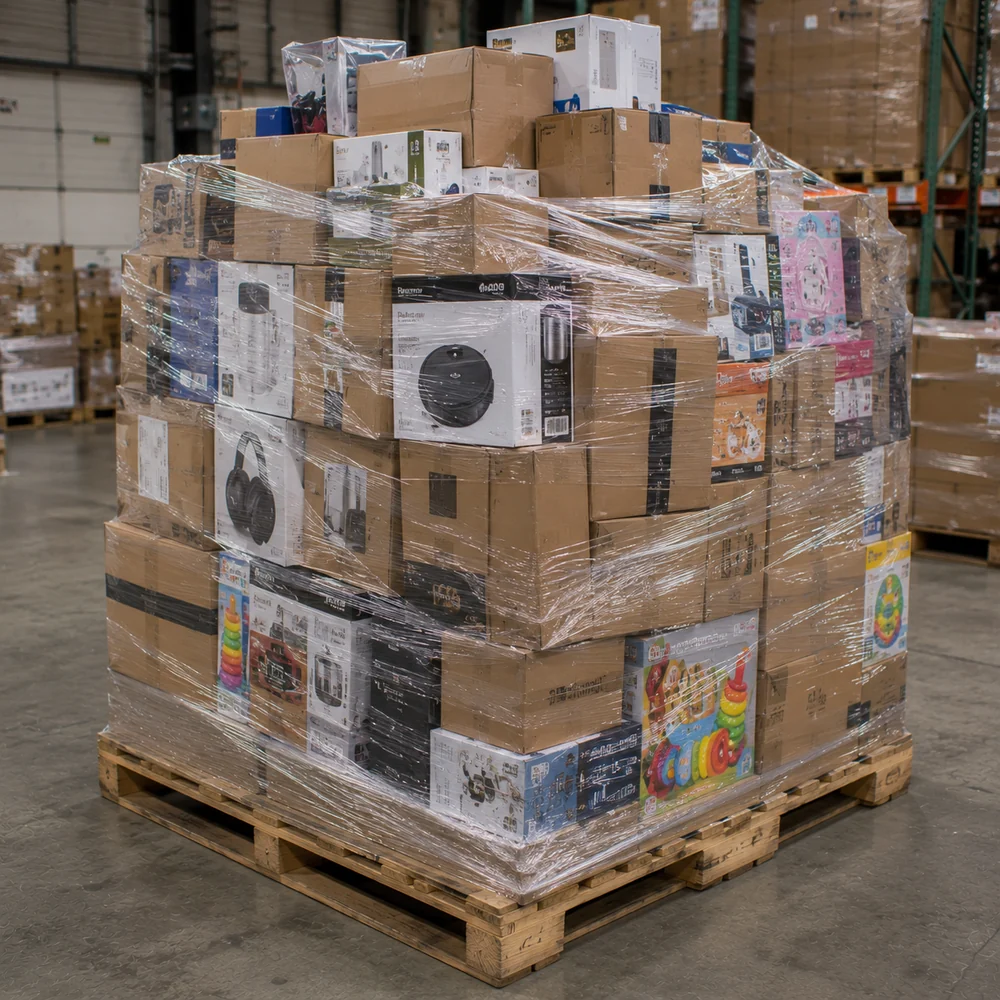
Amazon Return Pallets: 11 Smart Ways to Buy, Inspect & Resell in 2026
Amazon return pallets can be an interesting source of inventory for resellers, discount retailers, online sellers, flea-market operators and wholesalers. But if you have never bought liquidation merchandise before, it is easy to focus on the wrong number.
A pallet might look like a bargain because the merchandise originally sold for a much higher retail price. That does not necessarily mean the pallet is a good investment.
The real question is much simpler: what will the inventory actually cost you, and how much can you realistically recover after you receive it?
That is what this guide is about.
We will look at how Amazon return inventory works, what can be found inside a pallet, how condition affects value, how to read a manifest, how to estimate your real cost, how to avoid common buying mistakes, and how to turn a pallet into inventory that can actually be sold.
If you are already looking for inventory, you can also browse the current Amazon liquidation pallets and truckloads available from Dax Pallets.
Table of Contents
- What Are Amazon Return Pallets?
- Where Does Amazon Return Inventory Come From?
- What Can Be Inside an Amazon Return Pallet?
- Understanding Pallet Condition
- How to Read a Liquidation Pallet Manifest
- How to Calculate the Real Cost
- How to Buy Amazon Return Pallets
- How to Inspect a Pallet When It Arrives
- How to Resell the Inventory
- Amazon Return Pallet Scams and Red Flags
- Pallets vs. Truckloads
- Are Amazon Return Pallets Worth It?
- Frequently Asked Questions
- Contact Dax Pallets
What Are Amazon Return Pallets?
Amazon return pallets are bulk lots of merchandise that have entered a secondary liquidation channel. Depending on the particular load, inventory may include customer returns, overstock, shelf pulls, open-box products or other excess merchandise.
Instead of selling every individual item through the normal retail process, bulk inventory can be consolidated and sold to businesses that are prepared to sort, inspect, price and resell it.
That creates an opportunity for smaller businesses.
A reseller does not necessarily need to manufacture a product or purchase thousands of identical units directly from a manufacturer. A liquidation pallet can provide a mixture of inventory that can then be sold individually through online marketplaces, local sales channels, discount stores or other businesses.
However, liquidation inventory is different from conventional wholesale inventory.
With traditional wholesale, you may know exactly what you are receiving. With liquidation, condition and product mix can matter much more. That is why research before the purchase is so important.
Dax Pallets also has a dedicated guide explaining what Amazon liquidation pallets are if you want a shorter overview before comparing available inventory.
Where Does Amazon Return Inventory Come From?
There is no single reason why merchandise ends up in liquidation.
Large retail operations handle enormous volumes of products. Some inventory comes back because a customer changes their mind. Other products may be excess stock, discontinued merchandise, open-box inventory or products that no longer fit the retailer’s normal selling strategy.
Customer Returns
Customer returns can vary considerably.
A customer might return an item without ever using it. Another customer may open the packaging, test the product and decide it is not suitable. In other cases, an item may have been used, damaged or returned because of a functional problem.
That is why the phrase “customer return” should never be interpreted as meaning either “brand new” or “damaged.” The actual condition depends on the particular lot.
For a deeper explanation of the reverse-logistics process, Dax Pallets has published What Happens to Returned Goods?.
Overstock
Overstock is merchandise that a retailer or distributor has more of than it currently needs.
It can happen because of seasonal demand, purchasing decisions, product changes or simply because a product did not sell as quickly as expected.
For a reseller, overstock can be appealing because some lots may contain new merchandise that requires less preparation than used customer returns.
Shelf Pulls
Shelf pulls are products removed from normal retail sales channels. They may have been discontinued, replaced with newer products or removed to make room for other inventory.
Open-Box Inventory
Open-box merchandise has had its original packaging opened. The product may still be perfectly usable, but it should not automatically be treated as factory-sealed new inventory.
What Can Be Inside an Amazon Return Pallet?
This is one of the questions new buyers ask most often.
The honest answer is that the contents depend on the individual liquidation lot.
General merchandise loads can contain products from several different categories, including:
- Electronics and accessories
- Home and kitchen products
- Tools
- Clothing and footwear
- Toys and games
- Beauty and personal care
- Small appliances
- Office products
- Household merchandise
- General consumer goods
This variety can be useful for a reseller with several sales channels, but it can also mean more work.
For example, an electronics reseller may already know how to test devices, identify model numbers and research current market prices. A mixed household pallet may require a completely different process.
The best pallet is therefore not necessarily the one with the highest advertised retail value. It is the one that fits your customers, your storage space and your ability to sell the merchandise.

Understanding Pallet Condition
If you remember only one thing from this article, remember this: condition affects value.
A pallet full of new merchandise and a pallet containing mostly used returns may have completely different economics even if the product categories look similar.
| Condition | What It Generally Means | What the Reseller Should Consider |
|---|---|---|
| New | Unused merchandise | Usually requires less preparation, but verify the specific listing. |
| Overstock | Excess inventory | May contain new merchandise depending on the lot. |
| Shelf Pull | Removed from a retail sales channel | Packaging and presentation may vary. |
| Open Box | Original packaging has been opened | Testing and inspection may be necessary. |
| Customer Return | Returned by a customer | Condition can range from unused to defective. |
| Salvage | Lower-condition inventory | May require repair, parts recovery or additional processing. |
Never build your business plan around the assumption that every product will be ready to list the moment the pallet arrives.
Instead, think in categories: products ready to sell, products that need testing, products that need cleaning or repair, products worth selling for parts, and products that may not be worth processing.
How to Read a Liquidation Pallet Manifest
A manifest is one of the most useful tools available to a liquidation buyer when one is provided.
Depending on the particular listing, it may contain information such as product descriptions, SKUs, quantities, brands, model numbers or estimated values.
But there is an important distinction between retail value and resale value.
If a manifest shows an item with an original retail value of $300, that does not mean you will necessarily receive $300 when you resell it.
The actual market may be lower. The product could be an older model. It might be missing an accessory. It may have been opened. You may also have to pay marketplace fees, shipping, packaging and other expenses.
Use the manifest as a research tool rather than a promise of profit.
What Should You Look For?
- Product category
- Brand
- Model number
- Quantity
- Condition
- Current market demand
- Comparable resale prices
- Potential repair or testing costs

How to Calculate the Real Cost of an Amazon Return Pallet
This is where many new buyers get caught out.
The number on the product page is not necessarily your final cost.
Your calculation should include:
Pallet price
+ Freight and delivery
+ Taxes or duties where applicable
+ Testing and cleaning
+ Repairs
+ Packaging
+ Storage
+ Marketplace and payment fees
+ Your time and labor
That gives you a much better picture of your actual investment.
Freight Can Change the Deal
Imagine finding a pallet that looks inexpensive. Then you receive the freight quote and discover that transportation changes the economics completely.
That is why freight should be considered before you commit to a purchase, especially when buying multiple pallets or larger loads.
For general guidance on online purchasing, the Federal Trade Commission’s online shopping guidance recommends considering the total cost of a purchase, including shipping, taxes and other fees.
For international buyers, shipping arrangements can involve additional considerations. The U.S. Commercial Service shipping resources provide useful information about shipping options.
How to Buy Amazon Return Pallets: A Smarter Process
There is no reason to make your first liquidation purchase complicated.
A simple process can keep you from making expensive decisions based on excitement rather than numbers.
1. Decide What You Actually Want to Sell
Start with the customer, not the pallet.
If you already sell tools, for example, tool inventory may be easier for you to move than a mixed pallet of unfamiliar products.
If you sell online, consider product size, shipping costs and competition before buying.
2. Review the Actual Listing
Read the product description carefully.
Look at photographs, quantities, condition information and any available inventory details.
3. Research the Products
Search the products individually when possible.
Look at what comparable items are actually selling for rather than relying only on original retail prices.
4. Calculate Your Maximum Purchase Price
Work backward.
If you estimate that you can recover $4,000 from the inventory, you cannot simply spend $4,000 on the pallet and expect a profit.
Freight, fees, labor and unsellable products still need to be covered.
5. Confirm Shipping
Know where the inventory is shipping from and where it is going.
Dax Pallets explains its ordering and shipping process on the How to Order Liquidation Pallets page, including information customers may need to provide for delivery.
6. Ask Questions Before Paying
If you are unsure about condition, quantity, freight or the particular product, ask before completing the purchase.
That small step can save a great deal of confusion later.
Watch: Understanding Amazon Return Pallets
A video can make the liquidation process easier to understand, particularly if you have never worked with palletized inventory before.
How to Inspect a Pallet When It Arrives
The work does not stop when the freight truck leaves.
When your pallet arrives, take a few minutes to document the shipment before immediately breaking everything down.
Photograph the Shipment
Take photographs of the pallet, packaging, labels and visible damage.
Good documentation gives you a record of what arrived.
Sort the Products
Create separate areas for:
- Ready-to-sell products
- Products requiring testing
- Products requiring cleaning
- Products requiring repair
- Parts or salvage
- Products that are not economically worth processing
Test What Needs Testing
Electronics, appliances, tools and other functional products should be tested before you list them whenever practical.
Accurate listings are better for both you and your customers.
Keep Records
Record how much you paid, what you received, what required repair, what sold and what did not sell.
After several purchases, those records become extremely useful. You start to see which categories are worth buying and which ones consume too much time for the return they produce.

How to Resell Amazon Return Pallets
Once you have sorted the inventory, the next question is where to sell it.
There is no single perfect sales channel.
Your Own Website
Your own store gives you control over the customer experience and brand, although you are responsible for generating traffic and handling orders.
Online Marketplaces
Marketplaces can give you access to existing buyers, but fees, competition and shipping requirements need to be included in your calculations.
Local Sales
Large or heavy products can sometimes make more sense locally, where the buyer can collect the item rather than requiring you to ship it.
Discount and Bin Stores
Mixed liquidation merchandise can also work well for discount retailers and bin-style stores that sell products at different price points.
Wholesale to Other Resellers
If you have more inventory than you want to process individually, another option is selling groups of products to other resellers.
The key is to match the merchandise to the sales channel instead of forcing every product through the same process.
Amazon Return Pallet Scams: 9 Red Flags to Watch For
Because liquidation merchandise can appear extremely cheap, scammers sometimes use unrealistic discounts to attract buyers.
Be careful when you see:
- Unrealistic profit guarantees.
- Huge retail values with no supporting inventory information.
- No clear business identity.
- No meaningful contact information.
- Pressure to send money immediately.
- Requests for unusual payment methods.
- No clear shipping information.
- No written purchasing terms.
- Product photographs that appear unrelated to the actual inventory.
The FTC recommends researching sellers, reviewing shipping and return policies, looking carefully at product information, and keeping records of online purchases. Its guidance also warns consumers about payment methods that can make it difficult to recover money if something goes wrong. Read the FTC’s marketplace buying guidance.
That does not mean every inexpensive liquidation pallet is suspicious. It simply means that the cheaper the deal appears, the more important it is to understand exactly what you are buying.
Amazon Return Pallets vs. Truckloads
A pallet and a truckload serve different types of buyers.
A pallet requires less capital and less storage space. It can be a sensible way to learn how a particular category performs.
A truckload, on the other hand, requires considerably more storage and selling capacity but can make sense for established resellers, retailers, wholesalers and exporters.
Dax Pallets currently lists both pallet and truckload Amazon inventory. The live Amazon category includes general merchandise pallets as well as larger truckload options. View the current Amazon inventory.
For example, the category currently includes an Amazon General Merchandise Truckload and an Amazon High Piece Truckload, in addition to individual pallet listings. Inventory and availability can change, so check the live product pages before making a purchase.
You can also browse the dedicated liquidation truckload section.
Are Amazon Return Pallets Worth It?
They can be, but the answer depends on the individual deal.
The most profitable buyer is not necessarily the person who finds the cheapest pallet. It is often the person who understands the products, knows where to sell them and can process the inventory efficiently.
Think about it this way.
A $500 pallet that takes 50 hours to sort, repair, photograph and sell may be less attractive than a more expensive pallet containing products that your existing customers already want.
That is why experience matters.
After several purchases, you can start measuring:
- Average recovery
- Sell-through rate
- Average profit per item
- Time spent processing inventory
- Percentage of unsellable merchandise
- Freight cost per pallet
- Best-performing categories
Those numbers are far more useful than simply looking at a pallet’s advertised retail value.
11 Smart Rules for Buying Amazon Return Pallets
- Know what you are buying. Never purchase based only on a dramatic discount.
- Understand the condition. New, overstock, open-box and returns are not interchangeable.
- Research resale prices. Retail value is not the same as your expected selling price.
- Calculate freight. Your delivered cost is what matters.
- Know your customer. Buy inventory you have a realistic plan to sell.
- Leave room for losses. Some products may need repair or may not be worth selling.
- Start at a manageable scale. Learn before committing to large loads.
- Document everything. Keep invoices, photographs and purchase information.
- Test functional products. Accurate listings help protect your reputation.
- Track your results. Your own sales data becomes your best buying guide.
- Build relationships with reliable suppliers. Consistency matters when you want to scale.
Frequently Asked Questions About Amazon Return Pallets
What are Amazon return pallets?
Amazon return pallets are bulk lots of merchandise that can include customer returns, overstock, shelf pulls, open-box goods and other liquidation inventory. The exact contents and condition depend on the individual lot.
Are Amazon return pallets profitable?
They can be profitable, but profitability depends on the purchase price, freight, product condition, resale demand, operating costs and your ability to sell the inventory efficiently.
How much do Amazon return pallets cost?
There is no universal price. Pallet prices vary according to category, quantity, condition, product mix and other factors. The most useful number is your total landed cost rather than the pallet price alone.
What is an Amazon liquidation manifest?
A manifest is an inventory list that may provide information such as product descriptions, SKUs, quantities, brands, model numbers or estimated values. Use it as a research tool and not as a guarantee of profit.
Are customer return pallets always damaged?
No. Customer returns can include unused products, opened products, lightly used merchandise, damaged goods or defective products. Condition varies by liquidation lot.
Should beginners buy a pallet or a truckload?
A pallet generally requires less capital and storage capacity. A truckload requires more space and a stronger resale operation. For many new buyers, starting with a manageable quantity is a sensible way to learn the process.
Where can I buy Amazon return pallets?
Liquidation suppliers offer Amazon-related pallet and truckload inventory. Before purchasing, review the supplier, product information, condition, shipping costs and purchasing terms.
You can view Dax Pallets’ current Amazon liquidation inventory here.
Can I resell products from Amazon return pallets?
Reselling liquidation merchandise can be part of a legitimate resale business, but sellers should understand the condition and authenticity of the products they purchase and follow the rules of the sales channel they use.
What should I do when my pallet arrives?
Document the shipment, photograph the packaging, sort the inventory, inspect and test products where appropriate, and keep records of what you receive. Then price products based on their actual condition and current market demand.
Useful Dax Pallets Resources
If you are researching liquidation before buying, these pages can help you move from general information to the practical side of sourcing inventory:
Amazon Liquidation Pallets & Truckloads
What Are Amazon Liquidation Pallets?
What Happens to Returned Goods?
How to Order Liquidation Pallets
Payment & Shipping Information
Dax Pallets FAQs
Liquidation Truckloads
Wholesale Tool Pallets
Home Depot Liquidation Pallets
Walmart Liquidation Pallets
Target Liquidation Pallets
Costco Liquidation Pallets
Helpful External Resources
Good liquidation buying involves more than finding merchandise. It also means understanding the costs and risks involved in purchasing online and arranging transportation.
Federal Trade Commission — Buying From an Online Marketplace
Federal Trade Commission — Online Shopping
U.S. Commercial Service — Shipping Options
Ready to Buy Amazon Return Pallets?
If you have researched the inventory and are ready to discuss your next purchase, Dax Pallets can help you review available liquidation pallets, larger loads and shipping options.
For the latest availability, start with the Amazon liquidation inventory section.
If you need help before ordering, you can also contact Dax Pallets directly.
Contact Dax Pallets Liquidation
Address:
82 Navy Wharf Ct
Toronto, ON M5V 3M5
Canada
WhatsApp:
+1 (236) 951-8541
Email:
supply@daxpallets.com
Website:
https://daxpallets.com/
Final Thoughts
There is a reason Amazon return pallets continue to attract resellers: they give businesses another way to source merchandise in bulk without relying entirely on traditional wholesale channels.
But the opportunity is not simply about buying products cheaply.
The buyers who approach liquidation seriously look at the whole picture.
They understand condition. They research the products. They calculate freight. They know their customers. They leave room for unexpected costs. And, perhaps most importantly, they learn from every pallet they buy.
Start small if you are still learning.
Track what sells.
Track what does not.
Keep your numbers.
Then use that information to make your next purchase better than the last one.
When you are ready to see what is currently available, browse Amazon liquidation pallets and truckloads from Dax Pallets.
For questions about inventory, quantities or shipping, contact the Dax Pallets team or reach us directly through WhatsApp.

Pingback: Best Items To Resell From Liquidation Pallets: 15 Proven Picks For 2026