
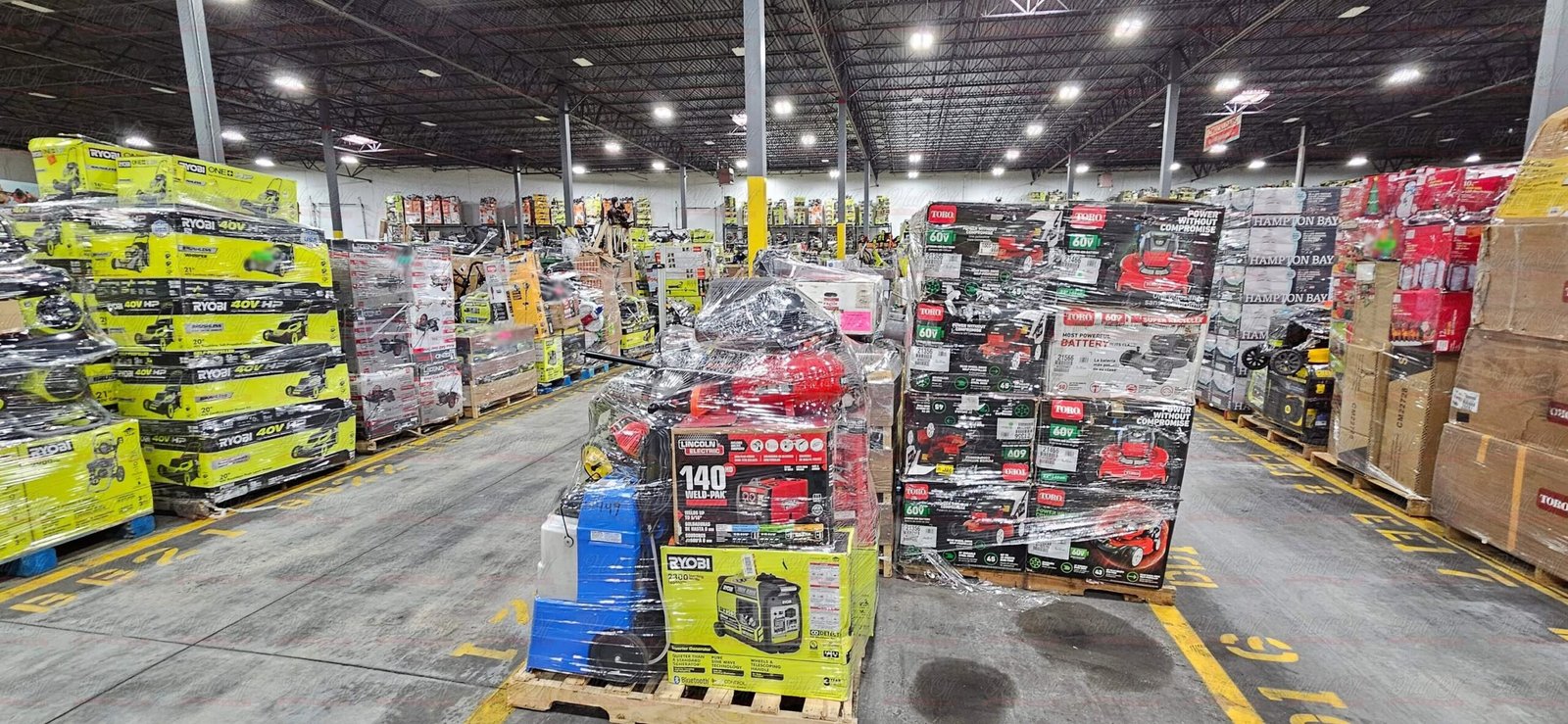
Pallet Flipping: 11 Smart Steps to Build a Profitable Reselling Business in 2026
Pallet flipping sounds simple when you hear it for the first time: buy liquidation merchandise at a wholesale price, separate the products, sell them individually and keep the difference.
In practice, there is quite a bit more to it.
The people who do well with liquidation inventory usually are not simply hunting for the cheapest pallet they can find. They are paying attention to what they buy, what condition it is in, how much freight will cost, where the products will be sold and how much time it will take to turn a pallet into cash.
That difference is important.
You can buy a pallet for a few hundred dollars and still lose money if the merchandise is difficult to sell. You can also spend more on a better-selected load and end up with a much easier inventory business.
In this guide, we will walk through the practical side of pallet flipping in 2026, from choosing your first load to pricing products, finding customers, tracking profit and eventually scaling into larger wholesale quantities.
If you are already looking for inventory, you can start by browsing the wholesale liquidation pallets available from Dax Pallets.
Table of Contents
- What Is Pallet Flipping?
- Why Is Pallet Flipping Popular in 2026?
- Choose the Right Product Category
- How Much Money Do You Need to Start?
- How to Choose a Liquidation Supplier
- Why Manifests Matter
- Calculate Your Real Cost Before Buying
- How to Choose Your First Pallet
- What to Do When Your Pallet Arrives
- Where to Sell the Products
- How to Price Liquidation Products
- 11 Mistakes New Pallet Flippers Make
- How to Scale From Pallets to Truckloads
- Turning Pallet Flipping Into a Real Business
- Frequently Asked Questions
- Contact Dax Pallets
What Is Pallet Flipping?
Pallet flipping is the process of purchasing liquidation merchandise in bulk and reselling the individual products or smaller groups of products for more than your total acquisition cost.
The merchandise may come from customer returns, overstock, shelf pulls, open-box inventory, closeouts or other surplus stock.
The basic idea is straightforward.
Buy wholesale inventory → receive and sort it → inspect and test it → price it realistically → sell it → track the results → reinvest into the next load.
What makes the model interesting is that you are not necessarily competing with traditional retail stores on the same terms. You are buying inventory in bulk and creating value by separating it into individual products that can reach different customers.
For example, one mixed pallet might contain kitchen products, small electronics, tools and household merchandise. A reseller can separate those products and sell each category through the channel that makes the most sense.
Dax Pallets explains the broader concept in its guide to liquidation pallets and how they work.
Why Is Pallet Flipping Popular in 2026?
Reselling has changed considerably over the last few years.
People can now reach customers through online marketplaces, social commerce, local selling platforms, their own websites, live selling and traditional physical retail.
That gives a small reseller more ways to move inventory than simply opening a storefront.
At the same time, the resale community has made liquidation much more visible. You can find pallet unboxings, warehouse tours, sourcing videos and reseller case studies across YouTube and social media.
That visibility is useful, but it can also create unrealistic expectations.
A video showing someone finding an expensive item inside a pallet is entertaining. It does not tell you what happened to the other products, how much the pallet cost, what freight was paid, how many hours were spent listing everything or how long the inventory took to sell.
That is why this guide focuses on the business side rather than the “treasure hunt” side of liquidation.
1. Choose the Right Product Category
One of the biggest mistakes beginners make is buying whatever pallet looks cheapest.
It is usually better to start with products you understand.
If you already know electronics, you may be comfortable checking model numbers, testing devices and researching market prices.
If you know tools, you may already understand brands, product differences and what contractors or DIY customers are looking for.
If clothing is your specialty, you may have a better understanding of sizes, brands, seasons and local demand.
Dax Pallets currently offers different categories depending on available inventory, including electronics, tools, home goods, apparel, general merchandise, boxes, pallets and truckloads. :contentReference[oaicite:4]{index=4}
You can explore wholesale tool pallets if tools are your niche, or browse the Amazon liquidation category when Amazon inventory fits your sourcing strategy.
Start With What You Can Sell
Think about the customers you already have.
If you sell through Facebook Marketplace, large household products may make sense because local buyers can collect them.
If you sell on eBay, smaller branded products may be easier to package and ship.
If you operate a physical store, general merchandise may give you more variety for your shelves.
The right pallet is the one that fits your operation.
2. How Much Money Do You Need to Start?
There is no single number that applies to every reseller.
Your starting budget should cover more than the pallet itself.
Think about four separate buckets:
- Inventory: the actual pallet or box lot.
- Freight: transportation from the supplier to your location.
- Operating supplies: boxes, tape, labels, cleaning products and other basic equipment.
- Cash reserve: money left over for unexpected costs.
A common beginner mistake is spending every dollar on the inventory and then discovering that freight or packaging costs are higher than expected.
It is better to have some breathing room.
If you intend to operate the activity as a formal business, also research the requirements in your location. The U.S. Small Business Administration’s current business guide covers planning, startup costs, business structures, registration, licenses, banking and other fundamentals. Read the SBA Business Guide.
U.S. businesses that need an EIN can obtain one directly from the IRS for free. Requirements depend on the business structure and circumstances, so check the IRS guidance rather than assuming every reseller needs one. See the IRS EIN information.
3. How to Choose a Liquidation Supplier
Your supplier can make or break your experience with liquidation.
Before purchasing, look beyond the price.
Check whether the supplier provides:
- Clear product descriptions
- Condition information
- Actual product photographs when available
- Quantity information
- Manifest information when applicable
- Shipping information
- Contact information
- Clear purchasing terms
- A published return or claims policy
You should also read the supplier’s policies before paying.
For example, Dax Pallets publishes its refund and returns policy, including information about liquidation merchandise, inspection of freight deliveries and documenting visible damage. :contentReference[oaicite:5]{index=5}
That kind of information is important because liquidation merchandise is not the same as buying a brand-new product from a conventional retail store.
4. Why Manifests Matter
A manifest can make the buying process much more practical.
When available, it may give you information about the products included in a particular load, such as product descriptions, quantities, SKUs, brands or model numbers.
That gives you something to research before committing your money.
But there is one number you should be careful with: estimated retail value.
Retail value is useful for understanding the scale of the merchandise, but it is not the same thing as your expected resale revenue.
A product that once sold for $200 may sell for considerably less today.
Its condition may have changed. A newer model may have replaced it. The market may have become crowded. It may be missing accessories.
And even after selling it, you may still have marketplace fees, payment processing, packaging and shipping expenses.
So use the manifest as a research document, not a promise of profit.
5. Calculate Your Real Cost Before Buying
This is where a lot of the excitement around liquidation disappears—and that is actually a good thing.
Once you calculate the numbers, you know whether you are looking at a business opportunity or simply a cheap-looking pile of merchandise.
Your calculation should include:
Inventory price + freight + taxes/duties where applicable + supplies + repairs + marketplace fees + storage + labor.
Then estimate how much of the inventory you realistically expect to sell.
Example
Imagine you purchase a pallet for $700.
Your freight costs $250.
You spend another $50 on packaging and basic supplies.
Your initial cost is already $1,000 before you sell anything.
Now suppose the inventory contains 50 products.
Your average acquisition cost before additional selling expenses would be approximately $20 per item.
That number is much more useful than saying, “The pallet has $3,000 in retail value.”
You can then research individual products and decide whether your expected selling prices justify the investment.
Dax Pallets explains the factors that affect freight pricing—including product weight, dimensions, number of pallets, destination and shipping method—on its Payment & Shipping page. :contentReference[oaicite:6]{index=6}
6. How to Choose Your First Pallet
Your first purchase should teach you something.
That sounds obvious, but it is easy to forget when you see a large pallet advertised at a dramatic discount.
For a first purchase, consider a load that is:
- Small enough to manage
- Within your available budget
- Suitable for your sales channel
- From a product category you understand
- Supported by useful product information
- Reasonable to store and process
You do not need to prove that you can handle a truckload on your first attempt.
One manageable pallet can teach you how much time it takes to unload, test, photograph, list, store and sell inventory.
After that, your next purchase can be based on actual experience rather than assumptions.
For buyers who want to compare different load sizes, Dax Pallets offers wholesale boxes and smaller lots as well as liquidation truckloads, depending on current inventory.
Watch: How to Buy Wholesale Liquidation Pallets
If you are new to liquidation sourcing, this video gives a useful visual introduction to buying wholesale liquidation pallets and evaluating the risks involved.
The video is educational rather than a guarantee of results. Your own supplier, product condition, freight costs and market will determine whether a particular purchase makes sense. :contentReference[oaicite:7]{index=7}
7. What to Do When Your Pallet Arrives
Do not rush straight into listing products.
First, document what arrived.
Photograph the Shipment
Take photographs of the pallet, wrapping, boxes, labels and any visible damage.
This is particularly important when receiving freight.
Dax Pallets advises buyers to inspect shipments for visible damage and document problems on the delivery receipt or Bill of Lading before signing where applicable. :contentReference[oaicite:8]{index=8}
Sort Everything
Create simple groups:
- Ready to sell
- Needs cleaning
- Needs testing
- Needs repair
- Parts or salvage
- Not worth processing
This simple system can save hours later.
Test Products
If you are selling electronics, tools, appliances or other functional merchandise, test the products before listing them whenever practical.
It is much better to discover a problem in your workspace than after a customer receives the product.
8. Where to Sell the Products
One of the biggest advantages of liquidation inventory is that you are not limited to one sales channel.
eBay
eBay can work well for smaller branded products, collectibles, electronics, tools and products with an established online market.
Facebook Marketplace
Facebook Marketplace can be useful for larger products that are expensive or inconvenient to ship.
Your Own Website
Your own store gives you more control over branding, customer relationships and the buying experience, but you also need to generate your own traffic.
Flea Markets and Local Stores
General merchandise can work well in physical selling environments where customers are comfortable browsing a wide selection.
Live Selling
Live-selling platforms can be useful for products that are easy to demonstrate or create excitement around.
The important point is to choose the selling channel before you buy when possible.
A pallet of large appliances is a very different business from a pallet of small electronics.
9. How to Price Liquidation Products
Pricing is where your research becomes money.
Do not automatically price every item according to its original retail price.
Instead, research what comparable products are actually selling for.
Consider These Factors
- Current market price
- Product condition
- Brand reputation
- Model and age
- Accessories included
- Competition
- Shipping cost
- Marketplace fees
- How quickly you want the product to sell
A product that could sell for $100 but takes three months to move may not be as useful to your business as a $60 item that sells within a few days.
Cash flow matters.
When you are starting out, getting your money back and keeping inventory moving can be more important than squeezing every last dollar out of every item.
10. Track Every Purchase
This is one of the least exciting parts of pallet flipping, but it is probably one of the most valuable.
Keep a simple spreadsheet.
| Information | What to Track |
|---|---|
| Purchase | Pallet price and supplier |
| Freight | Shipping and delivery costs |
| Inventory | Number of sellable items |
| Sales | Actual selling prices |
| Fees | Marketplace and payment fees |
| Expenses | Repairs, packaging and supplies |
| Profit | Net amount remaining after expenses |
After three, five or ten purchases, your spreadsheet starts telling you something important: what actually works for you.
You might discover that tools sell faster than electronics.
You might discover that local sales produce better margins than shipping.
You might discover that a certain category requires too much repair work.
That information is worth far more than somebody else’s “best pallet” list.
11. Mistakes New Pallet Flippers Make
Mistake 1: Buying Because the Discount Looks Huge
A large discount is not automatically a good deal.
Condition, demand and total cost matter more.
Mistake 2: Ignoring Freight
Always calculate delivered cost before deciding how much you can afford to spend.
Mistake 3: Assuming Retail Value Equals Profit
Retail value is not your resale revenue.
Mistake 4: Buying Too Much Too Soon
A truckload can sound exciting until you realize how much space and labor it requires.
Mistake 5: Not Testing Products
Especially with electronics and appliances, testing can prevent avoidable customer problems.
Mistake 6: Having No Selling Plan
Do not buy first and then ask where you are going to sell everything.
Mistake 7: Forgetting Your Time
Your time has value. If it takes an hour to prepare a product that only generates a small margin, that matters.
Mistake 8: Holding Dead Inventory Forever
Sometimes the best decision is to lower the price, bundle the item, sell it locally or move it through another channel.
Mistake 9: Chasing “Mystery” Inventory
Mystery pallets can be entertaining to watch online, but a business needs predictable information wherever possible.
Mistake 10: Failing to Research the Supplier
Check the supplier’s business information, policies, contact details and purchasing terms before paying.
Mistake 11: Expecting Instant Profit
The first pallet is a learning experience as much as an inventory purchase.
How to Avoid Liquidation Buying Scams
The growth of online resale has also attracted scammers.
Be cautious when a seller:
- Promises guaranteed profits
- Offers an expensive branded product at an unbelievable price
- Uses only stock photographs
- Provides no meaningful business information
- Refuses to answer basic product questions
- Pressures you to pay immediately
- Wants payment outside a platform’s normal protection system
The FTC recommends researching sellers and products, checking policies, comparing prices and keeping records of online purchases. It also warns buyers to be especially careful with payment methods that can make it difficult to recover money. Read the FTC’s online shopping guidance. :contentReference[oaicite:9]{index=9}
The FTC also recommends checking the seller’s contact information, shipping fees and return policies when buying through an online marketplace. Read the FTC marketplace buying guide. :contentReference[oaicite:10]{index=10}
How to Scale From Pallets to Truckloads
Once you have bought and sold several pallets successfully, you may begin thinking about larger quantities.
This is where the business starts to change.
Buying a truckload means more inventory, but it also means more responsibility.
You need enough:
- Storage space
- Working capital
- Labor
- Transportation capacity
- Customers
- Listing capacity
- Cash flow
If you can sell one pallet comfortably, that does not automatically mean you can sell 24 pallets.
Scale should follow your sales system.
Dax Pallets currently offers liquidation truckloads for buyers looking for larger quantities, with available inventory changing over time. :contentReference[oaicite:11]{index=11}
For larger orders, shipping can involve LTL freight, full truckload freight, international freight or ocean transportation depending on the product and destination. Dax Pallets provides further details on its Payment & Shipping page. :contentReference[oaicite:12]{index=12}
Turning Pallet Flipping Into a Real Business
There is a big difference between occasionally selling a few things and building a repeatable resale operation.
A real business needs a process.
Your process might look like this:
Source → receive → inspect → sort → test → photograph → list → sell → ship → record → reinvest.
Once that process becomes routine, you can begin improving each part.
Maybe you find a supplier offering better inventory.
Maybe you negotiate better freight rates.
Maybe you hire someone to photograph products.
Maybe you start using multiple selling channels.
Maybe you move from individual pallets into larger wholesale loads.
That is how pallet flipping can evolve from a side activity into a structured resale business.
What Type of Pallet Should a Beginner Buy?
There is no universal answer, but a beginner should generally look for inventory that is manageable, understandable and reasonably easy to sell.
General merchandise can offer variety.
Tools can be attractive for buyers who understand the category.
Electronics can offer strong resale demand but often require more testing.
Apparel can be easier to store but may require careful sorting by size, brand and condition.
Box lots can provide an even smaller way to test a category before moving into pallets.
Dax Pallets offers wholesale box lots alongside pallet and truckload inventory, subject to current availability.
How Shipping Affects Pallet Flipping Profit
Shipping is not just a logistics issue. It is part of your buying decision.
A pallet that costs $600 may look attractive. But if delivery adds another $300, your actual acquisition cost is $900.
For international buyers, there can also be customs duties, taxes, destination charges and other import-related costs.
That is why Dax Pallets recommends confirming shipping costs based on the destination, order size, product dimensions and delivery requirements before larger purchases. :contentReference[oaicite:13]{index=13}
Before ordering, review the Payment & Shipping information and provide accurate delivery details.
For a step-by-step purchasing process, visit How to Order Liquidation Pallets from Dax Pallets. :contentReference[oaicite:14]{index=14}
Is Pallet Flipping Worth It in 2026?
It can be, but it is not effortless money.
The opportunity is real because liquidation allows businesses to source merchandise in bulk and resell it through different channels.
The challenge is that the work happens after the purchase.
You have to receive the inventory.
You have to sort it.
You have to test it.
You have to photograph it.
You have to write listings.
You have to answer customers.
You have to package orders.
You have to deal with products that do not sell.
And you have to keep your numbers straight.
If you enjoy that process and build a system around it, pallet flipping can become a practical resale model.
If you are only interested in buying something cheaply and immediately making money, liquidation may be a frustrating business.
11 Smart Rules to Remember
- Buy for demand, not excitement.
- Know your total delivered cost.
- Research resale prices before purchasing.
- Understand the condition of the merchandise.
- Use manifests when available.
- Start with a manageable quantity.
- Choose your selling channel before buying.
- Test products before listing them.
- Track every expense.
- Move dead inventory instead of storing it forever.
- Scale only after your process works.
Frequently Asked Questions About Pallet Flipping
What is pallet flipping?
Pallet flipping is the practice of purchasing liquidation merchandise in bulk and reselling the individual products or smaller groups of products for more than the total acquisition cost.
Can beginners start pallet flipping?
Yes. Beginners can start with manageable quantities and learn how to evaluate condition, calculate costs, price products and sell through suitable channels before scaling.
How much does it cost to start pallet flipping?
The amount varies widely depending on the inventory and supplier. Your budget should account for the pallet, freight, supplies and a cash reserve rather than spending everything on the initial inventory.
Are liquidation pallets profitable?
They can be, but there is no guaranteed profit. Your results depend on the inventory, purchase price, condition, freight, selling channel, market demand and operating costs.
What is the best pallet for beginners?
There is no single best pallet. A good beginner choice is usually a manageable load containing products you understand and already have a realistic way to sell.
Do I need a business license to flip pallets?
Requirements depend on your location, business structure and selling activity. Research your local and state or provincial requirements before operating at scale.
Should I buy a pallet or a truckload?
A pallet generally requires less capital and storage. A truckload requires substantially more space, working capital and sales capacity. Most beginners should prove their process on smaller quantities first.
Where can I buy liquidation pallets?
Liquidation suppliers offer pallets, boxes and truckloads from different categories. Buyers should research the supplier, inventory condition, product information, shipping and purchasing terms before ordering.
You can browse the current Dax Pallets wholesale liquidation inventory.
What should I do when a pallet arrives?
Inspect the shipment, photograph visible damage, verify the number of pallets or boxes, sort the products, test appropriate merchandise and keep your shipping documentation.
Can I make pallet flipping a full-time business?
It can grow into a larger resale operation, but that requires repeatable sourcing, reliable sales channels, inventory management, sufficient working capital and careful financial tracking.
Helpful Dax Pallets Resources
If you are researching your first purchase or planning to scale, these Dax Pallets resources can help:
Shop Wholesale Liquidation Pallets
Amazon Liquidation Pallets & Truckloads
Wholesale Tool Pallets
Wholesale Box Lots
Liquidation Truckloads
The Ultimate Guide to Liquidation Pallets
What Happens to Returned Goods?
How to Order Liquidation Pallets
Payment & Shipping
Dax Pallets FAQs
Refund & Returns Policy
Useful External Resources
Building a resale business also means understanding basic business setup, online purchasing safety and tax requirements.
U.S. Small Business Administration — Business Guide
IRS — Employer Identification Number
FTC — Online Shopping Safety
FTC — Buying From an Online Marketplace
Ready to Start Pallet Flipping?
The first step is not buying the biggest pallet you can afford. It is finding inventory that makes sense for your budget, your customers and your selling strategy.
Browse the current wholesale liquidation pallets from Dax Pallets and compare the available inventory, quantities and product information.
If you need help deciding which load fits your business, contact the Dax Pallets team before ordering.
Contact Dax Pallets Liquidation
Address:
82 Navy Wharf Ct
Toronto, ON M5V 3M5
Canada
WhatsApp:
+1 (236) 951-8541
Email:
supply@daxpallets.com
Contact Page:
Contact Dax Pallets Liquidation
Ordering:
Learn How to Order
Final Thoughts
Pallet flipping can look very different from what you see in a ten-minute unboxing video.
The exciting part is opening the pallet and seeing what is inside.
The business part comes afterward.
You need to know what you paid, what the products are worth today, what condition they are in, where you can sell them and how much it costs to turn inventory into cash.
That is the difference between randomly buying liquidation merchandise and building a resale business.
Start with a manageable load.
Learn your numbers.
Pay attention to what sells.
Improve your process.
Then scale when the numbers justify it.
If you are ready to take the next step, explore the latest Dax Pallets liquidation inventory, or contact the team to discuss pallets, boxes, truckloads and available shipping options.